

ChatGPT now shows ads. For the first time, brands can place sponsored content directly inside the conversations hundreds of millions of people have with OpenAI’s assistant every week and the rules for winning there look nothing like the Google Ads or Meta Ads playbook most marketing teams have spent a decade mastering.
This guide breaks down what ChatGPT Ads are, how they work, who is currently eligible to run them, and the features and targeting tools available as of August 2026. It also explains why the fastest-moving, least-understood ad platform in years is exactly the kind of channel where working with an experienced digital marketing agency pays for itself.
Note: OpenAI’s advertising platform is new and evolving quickly: eligibility, pricing, and features have already changed several times since launch. The details below reflect publicly available information as of August 2026; a quick call with our team is the fastest way to confirm what applies to your account today.
What Are ChatGPT Ads and How Do They Work?
ChatGPT Ads are sponsored placements that OpenAI began testing in early 2026 to help fund free access to ChatGPT. According to OpenAI’s own announcement, ads appear as clearly labeled “Sponsored” listings that are visually separated from ChatGPT’s organic answer, the model’s response itself is never influenced by advertiser payments.
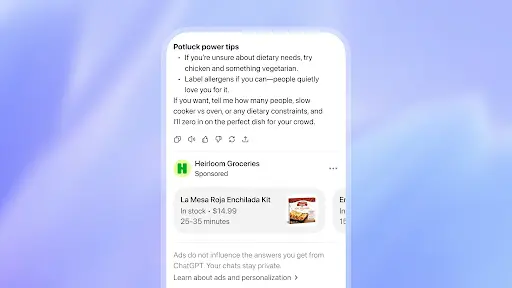
Image source: https://openai.com/index/testing-ads-in-chatgpt/ (17/08/2026)
Here’s the mechanic in plain terms: when a user’s conversation touches on a commercial topic (say, meal-kit delivery or business software), OpenAI’s system matches that context against active advertiser campaigns and surfaces the most relevant sponsored listing alongside and not inside the answer. Matching draws on the current conversation, and, where a user has personalization enabled, relevant past chats and prior ad interactions. Importantly, OpenAI states that advertisers never see a user’s chats, chat history, memories, or personal details; targeting happens on OpenAI’s side using aggregated signals, not raw conversation data handed to brands.
Where and to Whom ChatGPT Ads Appear
Ads are currently limited to logged-in adult users on ChatGPT’s Free and Go tiers. Plus, Pro, Business, Enterprise, and Education subscribers do not see ads. OpenAI has also said it avoids showing ads alongside sensitive or regulated topics such as health, mental health, or politics, and excludes under-18 accounts entirely.
The Auction Behind the Scenes
Ad delivery runs on what’s been described as a relevance-weighted, second-price auction, similar in spirit to Google and Meta’s auction models. That means the highest bidder doesn’t automatically win; ad quality, creative relevance, and landing-page experience all factor into which sponsored listing is shown. This is one of several reasons agencies that already understand auction dynamics on other platforms tend to ramp up faster on ChatGPT than teams starting from scratch. If you want a second opinion on how this fits your existing paid media mix, our digital marketing strategy team can walk through it with you.
Who Can Advertise on ChatGPT? Eligibility and Country Availability
Not every business or industry can run ChatGPT Ads yet. Based on OpenAI’s Ads Manager policies as reported by early advertisers and agency partners, approved categories generally include consumer goods, retail and e-commerce, travel, local and home services, education, and digital products or software. Regulated or sensitive categories including health and health claims, financial and legal services, alcohol and tobacco, gambling, dating, and political advertising are restricted or subject to manual, case-by-case review rather than automatic approval. If your business sits in one of these gray areas, that review process is exactly where an agency that already has a working relationship with the format can save you weeks.
Eligibility to open a ChatGPT Ads Manager account depends on two things: the country where your business is legally registered, and the activity category you declare. Get either one wrong and your account setup or campaign approval can be denied and the account’s country designation is generally permanent once set, so it’s worth getting right the first time.
Countries Where ChatGPT Ads Are Currently Available (August 2026)
OpenAI has expanded ChatGPT Ads market by market rather than launching globally. As of August 2026, businesses can open advertiser accounts and run live campaigns in:
- Australia
- Brazil
- Canada
- Japan
- Korea
- Mexico
- New Zealand
- United Kingdom
- United States
Because this list is changing quickly and new markets are added with little advance notice, treat any country list including this one as a snapshot rather than a permanent fact. If you’re evaluating whether ChatGPT Ads are available for your market and business type right now, our team tracks these updates closely; you can get in touch and we’ll confirm current eligibility before you invest any budget.
Starting the week of August 23 (2026), ChatGPT Ads is expanding to 31 European countries as well. The rollout includes markets across Europe, including Germany, France, Spain, Italy, Sweden, Norway, Denmark, the Netherlands, and Austria, along with 22 additional European countries.
The Latest ChatGPT Ads Features and Developments
ChatGPT Ads has moved fast since its limited pilot in February 2026. Here’s what’s changed and what’s new heading into the second half of 2026.
Self-Serve ChatGPT Ads Manager and Lower Entry Barriers
OpenAI opened a self-serve Ads Manager beta in May 2026, letting advertisers set up and manage campaigns directly rather than going through a manual pilot process. Early reporting pointed to a substantial minimum ad-spend requirement during the invite-only pilot phase (reported figures varied by source, generally in the tens of thousands of dollars); that fixed minimum was removed with the self-serve rollout, opening the platform to small and mid-market advertisers rather than only large brands. Major agency holding companies (including Dentsu, Omnicom, Publicis, and WPP) and ad-tech partners such as Adobe, Criteo, Kargo, Pacvue, and StackAdapt can also manage ChatGPT campaigns on behalf of clients a strong signal that OpenAI expects most advertisers to run this channel through experienced partners rather than in-house alone.
Customer Lists (Custom Audiences) for Targeting and Exclusion
One of the most talked-about recent additions is Customer Lists, OpenAI’s version of the custom-audience matching that Meta and Google have offered for years. In its current beta form, advertisers can upload a CSV or TXT file of customer identifiers (raw or SHA-256-hashed email addresses and phone numbers) to build an audience used either for targeting or for exclusion.
A few practical details matter here: uploaded lists reportedly need to reach at least 25,000 identifiers before OpenAI will activate them, and match rates depend on whether the emails or phone numbers in your list line up with what a user registered their ChatGPT account with which won’t always be the same address they gave your business. In practice, that threshold puts Customer Lists out of reach for many smaller advertisers for now, though it’s a meaningful step toward the kind of retargeting and audience-exclusion control marketers expect from mature ad platforms. Agencies running multi-channel campaigns are well positioned to prepare and hygiene-check these lists correctly the first time, since a poorly formatted file simply won’t match.
Commerce and Shopping Integrations
For retail and e-commerce brands, OpenAI has been building out catalog integrations – including a Shopify connection – that let merchants sync product feeds so ChatGPT can surface real products with current pricing directly inside relevant shopping conversations, rather than a generic text ad.
Measurement Tools: Pixel and Conversions API
OpenAI has introduced browser and server-side measurement tooling (commonly referred to in the industry as the OAIQ pixel) that tracks standard events like page views, searches, add-to-cart actions, sign-ups, leads, and purchases via a first-party tracking cookie, plus a server-side Conversions API for advertisers who prefer not to rely on browser-side tracking alone. Integration with established mobile measurement partners (such as AppsFlyer, Adjust, Branch, and Singular) has also been rolled out, which matters most for app-install advertisers. Ads Manager reporting covers impressions, clicks, CTR, average CPC/CPM, and conversions, with CSV export and an Insights API for advertisers who want to pull data into their own dashboards.
Targeting, Campaign Management, and Optimization Opportunities
What You Can (and Can’t) Target Today
Compared with Google Ads or Meta Ads, ChatGPT’s self-serve targeting is still relatively limited and that’s actually the point marketers most underestimate. Current controls generally include:
- Country/geo targeting: include or exclude countries at the campaign level
- Context hints: broad, advertiser-written descriptors of intent and theme at the ad-group level (closer to a topic brief than a keyword list)
- Customer Lists: audience matching / exclusion via hashed or raw contact data, subject to the volume threshold above
What most self-serve advertisers don’t yet get direct access to: granular demographic targeting, lookalike audiences, device-level targeting, and placement controls – the bread-and-butter levers of Meta and Google campaigns. Delivery is also shaped by internal signals (conversation relevance, language, and personalization history) that OpenAI controls rather than the advertiser. That gap is exactly why context-hint writing and creative relevance currently do more heavy lifting on ChatGPT than on legacy platforms: a very different skill set from bidding on keyword lists. For a deeper look at how this fits into a broader, data-informed media plan, see our data-driven decision-making services.
Bidding and Budgets
As of August 2026, advertisers can choose among three campaign objectives in ChatGPT Ads: CPM for reach and awareness, CPC for clicks and traffic, and oCPC (conversion-optimized cost per click) for optimizing toward a specific downstream conversion. OpenAI uses a relevance-weighted, second-price auction, so a higher bid does not automatically guarantee an ad placement; eligible ads are selected based on a combination of bid and relevance signals, including the context and intent of the conversation.
Self-serve advertisers set either a daily or campaign-total budget. There is a minimum daily budget, currently $25 per campaign in the United States, with minimums varying by market. Actual delivery and spend can vary depending on factors such as the campaign objective, budget, bid competitiveness, eligible conversation opportunities, and ad relevance.
Campaign Management Workflow
A typical ChatGPT Ads campaign moves through account registration and verification, campaign setup (objective, budget, schedule, and country targeting), ad-group creation with context hints, creative upload (headlines and descriptions have tight character limits, so precision matters), and a policy review before anything goes live. Once running, Ads Manager supports performance monitoring, inline edits, team permissions, and billing either managed directly or through an approved agency and ad-tech partner.
Image source: https://help.openai.com/en/articles/20001207-ads-in-chatgpt-the-basics (17/08/2026)

Where the Optimization Opportunities Are
Because ChatGPT Ads rewards relevance as much as bid size, the highest-leverage optimization work right now is on the creative and context side: mapping the actual, detailed questions your customers type into ChatGPT (not a keyword list), writing “answer-first” landing pages that address the user’s underlying question before pitching the product, and iterating quickly as OpenAI continues to adjust auction dynamics and policy. Add in pixel/Conversions API data to close the loop on what’s actually converting, and you have a channel that rewards continuous testing far more than “set and forget” campaign structures.
How ChatGPT Ads Differ from Google Ads and Meta Ads
ChatGPT Ads sit in a genuinely different category from search and social advertising, which is exactly why treating it as “Google Ads with a new UI” or “Meta Ads for chat” tends to underperform.
| Dimension | ChatGPT Ads | Google Ads | Meta Ads |
|---|---|---|---|
| User intent | Conversational, problem-based intent. | Search intent + interest-based discovery. | Interest, behavior, and demographic signals. |
| Ad format | Sponsored ads alongside ChatGPT responses. | Search ads + visual Display/Demand Gen ads. | Image, video, carousel, and Stories/Reels ads. |
| User mindset | Actively solving or deciding. | Searching or discovering. | Primarily browsing and discovering. |
| Targeting | Conversation context and relevant signals. | Keywords + interests, audiences, and behavior. | Interests, behaviors, demographics, and AI audiences. |
| Tracking | Advertiser-side conversion tracking and measurement. | Google tag, enhanced conversions, and first-party signals. | Meta Pixel + Conversions API. |
| Campaign model | CPC, oCPC or CPM campaigns. | Search + AI-optimized Display/Demand Gen campaigns. | Objective-based, increasingly AI-automated campaigns. |
| Best suited for | High-intent, complex decisions and consideration. | Capturing demand and generating new demand. | Discovery, ecommerce, leads, and brand awareness. |
| Core advantage | Understands the problem behind the query. | Combines intent with massive reach. | Combines scale with rich social signals. |
| Platform maturity | Emerging and rapidly expanding. | Highly mature and continuously evolving. | Highly mature and AI-driven. |
The practical takeaway: ChatGPT users have often already described their need in more detail than a search query ever captures, which can make the traffic feel highly qualified but the targeting and optimization toolkit to act on that context is still being built out. Winning here requires a different kind of media strategy than porting over your existing Google or Meta account structure.
Practical Examples and Use Cases
While ChatGPT Ads is still early, a few patterns are emerging across the businesses testing it:
E-commerce and retail. Brands with a synced product catalog (via Shopify or similar integrations) can appear with real products and live pricing when a user asks a shopping-related question for example, someone comparing running shoes or asking for gift ideas within a budget.
Local and home services. Businesses like HVAC, solar, and home-improvement contractors are testing sponsored listings against conversational prompts such as “I need a contractor to replace my AC unit” a much more qualified signal than a generic search term.
Education and training providers. Ads appearing alongside career-advice or skills-related conversations let education brands reach people at the exact moment they’re evaluating options, rather than relying on a lower-intent display placement.
Software and digital products. Approved SaaS and digital-product categories can surface tools directly inside problem-solving conversations, where a user has already explained what they’re trying to accomplish.
Early results across these categories vary by advertiser, creative quality, and how well context hints match real user language, which is why disciplined testing, rather than guesswork, is what separates strong performance from wasted budget in a new channel like this. You can see how we approach that kind of test-and-learn media strategy across channels in our client case studies.
Why Work With a Specialized ChatGPT Ads Agency
ChatGPT Ads is arguably the fastest-changing major ad platform to launch in years: pricing models, eligibility rules, targeting tools, and even country availability have shifted multiple times since February 2026. A few reasons that matters for your business:
- The rulebook keeps changing. Minimum spend requirements, approved categories, and available markets have all moved since launch. An agency actively managing ChatGPT campaigns catches these changes as they happen, not weeks later.
- Context hints require a different skill than keyword bidding. Writing effective ad-group context and “answer-first” landing pages is closer to conversational copywriting than traditional PPC – a muscle most in-house teams haven’t built yet.
- Eligibility and category review can be a maze. Getting a regulated or borderline category approved, or setting up your account in the right country the first time, is easier with a partner who has already been through the process.
- Measurement needs to connect to the rest of your funnel. Pixel and Conversions API data are only useful if they feed into the same reporting and decision-making framework you use for Google and Meta, which is where genuinely data-driven decision-making matters most.
- It needs to fit your broader strategy, not run in isolation. Deciding how much budget ChatGPT Ads deserves relative to Search and Social is a strategic question, not just a media-buying one – the kind of question our strategic consulting services are built to answer.
At MarketingLens, we treat new ad platforms the way we treat any channel: test deliberately, measure honestly, and scale only what’s actually working. You can learn more about our approach on our digital marketing services page or read about our team on the About Us page.
Conclusion: Is Now the Right Time to Try ChatGPT Ads?
ChatGPT Ads is still a young channel, but it’s growing quickly, expanding into new markets, and shipping new features such as customer lists, commerce integrations, improved measurement at a pace that rewards businesses who start testing early over those who wait for the platform to fully mature. The flip side of that opportunity is real complexity: shifting eligibility rules, a narrower targeting toolkit than Google or Meta, and a creative approach that has to be built from scratch rather than copied from your existing campaigns.
That combination is exactly the situation where a specialized digital marketing agency earns its keep. If you’re weighing whether ChatGPT Ads belongs in your 2026 marketing mix, or you want someone already tracking these changes to manage it for you, we’d like to talk.
Ready to explore ChatGPT Ads for your business? Schedule a free consultation with MarketingLens and we’ll assess your eligibility, competitive landscape, and growth potential on ChatGPT Ads – no obligation required. You can also reach our team directly through our contact page.
Frequently Asked Questions
What are ChatGPT Ads?
ChatGPT Ads are sponsored, clearly labeled listings that OpenAI shows alongside ChatGPT’s answers to logged-in adult users on the Free and Go tiers. They are matched to the topic of a conversation and are visually separated from ChatGPT’s organic response.
How much do ChatGPT Ads cost?
Advertisers bid using either a cost-per-click (CPC) or cost-per-mille/impression (CPM) model inside a relevance-weighted auction, so final cost depends on competition, creative quality, and landing-page relevance rather than a fixed rate. There is currently no fixed minimum spend required to start, following OpenAI’s move to self-serve access in May 2026.
Which countries currently allow ChatGPT Ads?
As of August 2026, businesses can open advertiser accounts and run campaigns in the United States, Canada, United Kingdom, Australia, New Zealand, Japan, South Korea, Mexico, and Brazil, with additional markets announced but not yet fully live. Availability changes frequently, so it’s worth confirming current status before launching a campaign.
Who is eligible to advertise on ChatGPT?
Eligibility depends on where your business is legally registered and the product or service category you declare. Categories such as consumer goods, retail, e-commerce, travel, education, and digital products are generally approved, while regulated categories like health, finance, legal, gambling, alcohol, and political advertising face restrictions or manual review.
Does ChatGPT show ads to all users?
No. Ads are shown only to logged-in adults on ChatGPT’s Free and Go plans. Paid subscribers on Plus, Pro, Business, Enterprise, and Education tiers do not see ads, and OpenAI excludes accounts belonging to users under 18.